


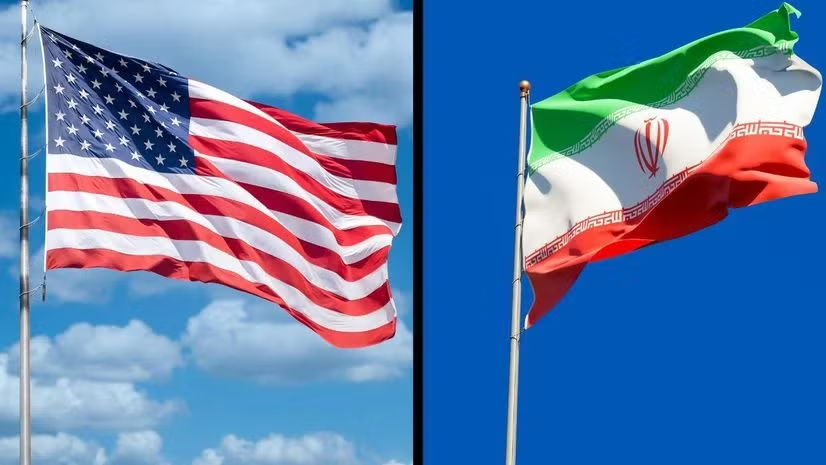
Vice President JD Vance met Iranian officials in Switzerland on Sunday as fragile peace negotiations continued under rising global tension. The talks involved a senior Iranian delegation and top US figures, including special envoy Steve Witkoff and adviser Jared Kushner. Mediators from Qatar and Pakistan also joined the discussions.
The meeting focused on the technical details of a recent memorandum of understanding signed last week. The agreement aims to reduce tensions and build a framework for limited cooperation. However, the situation on the ground has quickly become more unstable, putting the deal under pressure.
Fighting between Israel and Hezbollah in Lebanon has added fresh strain to the talks. Iran has said the conflict will be a central issue in negotiations. The violence has raised fears that the broader region could slide into a wider confrontation if diplomacy fails.
At the same time, Iran announced it had closed the Strait of Hormuz, a key global shipping route. Around 20 percent of the world’s oil passes through this narrow waterway. Tehran said the move was in response to alleged ceasefire violations by Israel. The US military has rejected Iran’s claim that it controls or can fully shut the strait.
Despite the rising tensions, JD Vance said early progress was made during the talks. He described the discussions as constructive and said they aimed at building a future of cooperation and stability. His comments suggested cautious optimism, even as political leaders exchanged strong warnings.
Shortly after the talks, US President Donald Trump issued a strong public statement. He warned Iran on social media that further escalation would lead to heavy military retaliation. He specifically referred to Iran’s regional proxy forces in Lebanon and demanded restraint.
In a separate interview, Trump also warned that the United States would respond forcefully if the Strait of Hormuz was closed. His comments added pressure on the negotiations and increased concerns about possible military escalation. The sharp tone contrasted with the diplomatic language used inside the talks in Switzerland.
The Iran situation has also triggered strong reactions in US politics. Some lawmakers have raised concerns about the direction of the negotiations. Critics argue that current policies risk worsening instability in the Middle East. They say both diplomatic and military approaches must be carefully balanced to avoid further conflict.
Former US defense officials have also expressed caution. They have pointed to unresolved questions in the recent memorandum of understanding. They argue that key security and enforcement details remain unclear. This has raised doubts about how durable the agreement will be in practice.
The involvement of regional mediators such as Qatar and Pakistan highlights efforts to keep communication channels open. These countries have played roles in previous diplomatic efforts involving Iran and Western powers. Their presence suggests that regional stability remains a shared concern among multiple governments.
However, the broader situation remains highly uncertain. Ongoing violence in Lebanon, tensions in the Gulf, and political pressure in Washington all contribute to a fragile environment. Each development appears to affect the negotiations in real time.
The Strait of Hormuz remains a major point of concern. Any disruption to shipping through the waterway could have immediate effects on global oil markets. This makes the situation not only a regional issue but also a global economic risk.
As talks continue, officials on all sides face increasing pressure to avoid escalation. Diplomatic progress remains possible, but the combination of military tension and political rhetoric has made the path forward more complicated. The coming days are expected to be critical for the future of the agreement and regional stability.

