


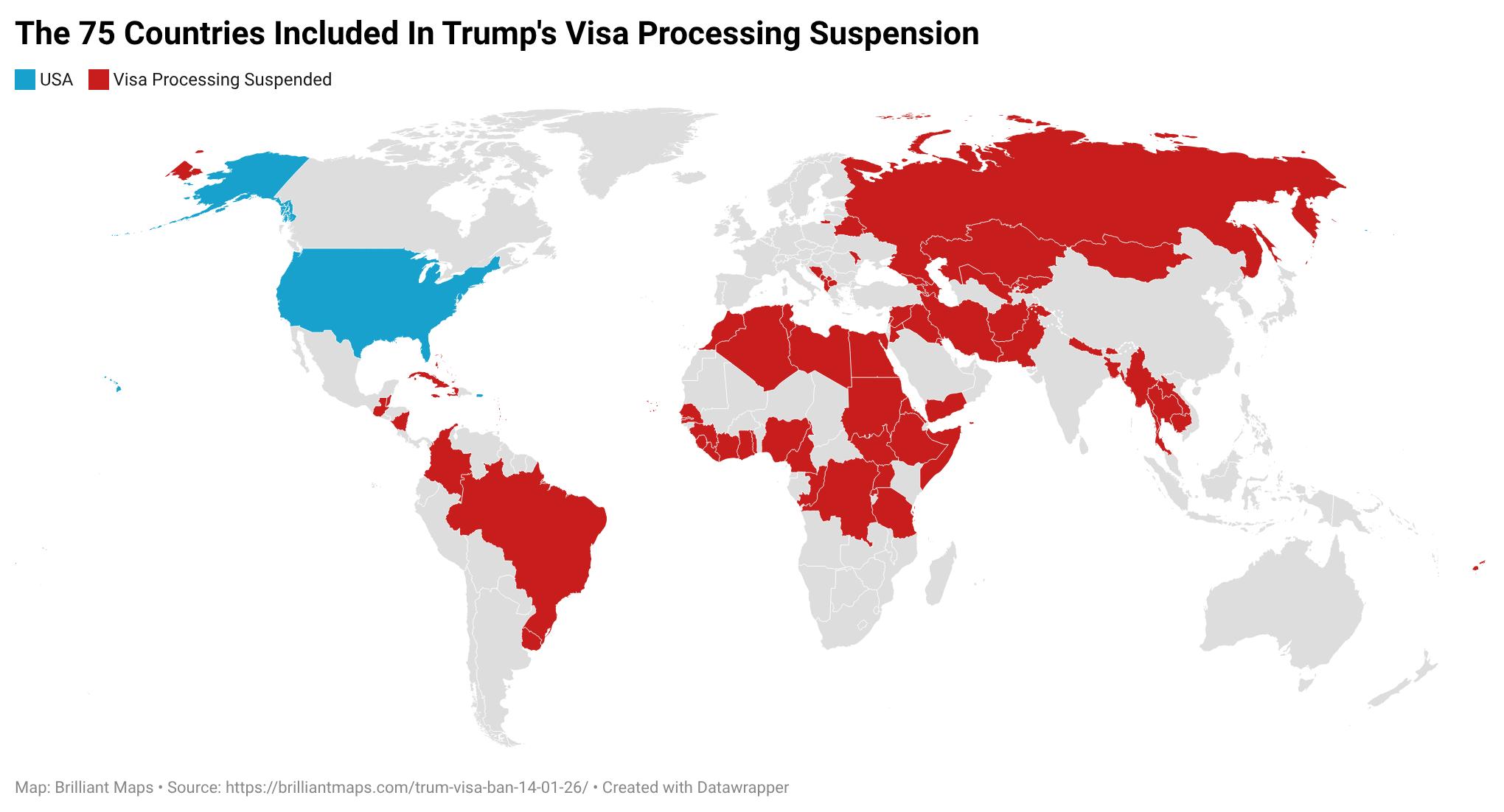
A US federal judge has struck down a Trump administration policy that suspended immigrant visa processing for people from 75 countries, dealing a major blow to one of the administration’s immigration measures.
US District Judge Jeannette Vargas ruled on Friday that the policy went beyond the authority given to the State Department. She said the government could not use the policy to stop visa processing based mainly on a person’s nationality.
The policy was issued in January by Secretary of State Marco Rubio. It paused the processing of immigrant visas for applicants from 75 countries across several regions. The administration said the measure was aimed at people who might become dependent on public benefits after entering the United States.
The court ruling removes the suspension and allows the affected visa process to move forward under the normal rules. The decision is important for families who have been waiting for immigrant visas and for US citizens or lawful residents seeking to bring relatives to the country.
The case was brought by immigrant rights groups, affected applicants and US citizens who were sponsoring family members. They argued that the government had used a broad rule to block people based on nationality rather than reviewing each applicant’s case.
Judge Vargas rejected that approach. She said immigration law gives consular officers a role in deciding whether an individual qualifies for a visa. The ruling found that the State Department did not have the power to replace that process with a broad suspension covering people from entire countries.
The decision affects countries in Latin America, the Balkans, South Asia, Africa, the Middle East and the Caribbean. Bangladesh is among the countries affected by the policy.
For many applicants, the ruling could provide a path forward after months of uncertainty. An immigrant visa can be a key step for people seeking permanent residence in the United States through family or other legal routes.
The case also highlights a larger legal fight over Trump’s immigration program. Since returning to office, Trump has pushed for tighter immigration controls and broader executive action. His administration has argued that stronger restrictions are needed to protect national security and reduce pressure on public services.
Courts, however, have repeatedly been asked to decide whether those actions stay within the limits of federal law. The latest ruling shows that immigration policy can face major limits when courts find that an administration has gone beyond the power granted by Congress.
The decision does not mean that every immigrant visa application will now be approved. Applicants must still meet the legal requirements for an immigrant visa. Consular officers can continue to review individual cases under US immigration law.
The ruling also does not remove other immigration restrictions that may apply to people from specific countries. It focuses on the policy that paused immigrant visa processing for the 75 affected countries.
The State Department has not publicly announced a full response to the ruling. The administration could seek further court review, which could keep the legal dispute alive.
For families affected by the suspension, the immediate issue is whether visa processing will return to normal. That process may take time, especially if consular offices must deal with a large number of cases that were delayed during the pause.
The ruling may also have a wider political effect. Immigration remains one of the most divisive issues in the United States. The Trump administration has made tighter border and immigration controls a central part of its policy agenda.
The court decision now adds another challenge to that agenda. It shows that even major immigration measures can be tested in court when they affect large groups of people.
For now, the ruling gives affected applicants a legal victory. It also sends a clear message that immigration policy must follow the limits set by Congress and federal law, even when the government argues that broad action is needed for public safety or economic reasons.

