


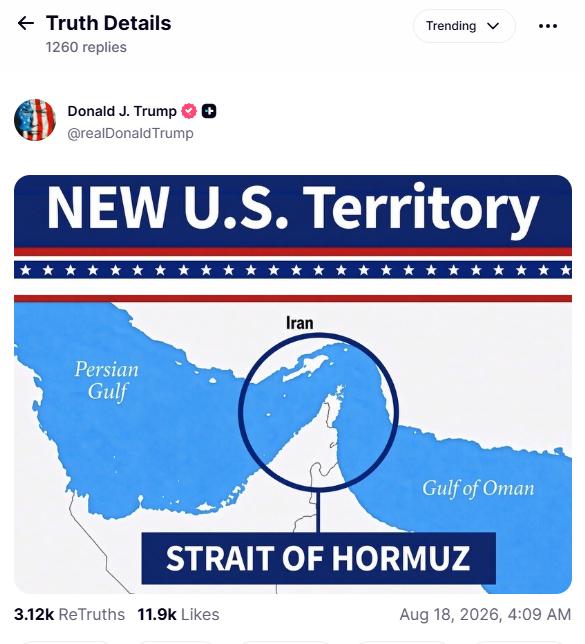
President Donald Trump has again shared a map that labels the Strait of Hormuz as “NEW US territory,” adding to a growing dispute over one of the world’s most important shipping routes.
Trump posted the image on Truth Social on Sunday without a long explanation. The post came as the United States and Iran remain locked in a serious dispute over the waterway. Washington has also increased economic pressure on Tehran.
The Strait of Hormuz links the Persian Gulf with the Gulf of Oman and the wider Arabian Sea. It is a key route for energy shipments. Before the current war, a large share of the world’s oil and liquefied natural gas passed through the strait.
The new post does not create any legal change to the status of the waterway. The strait is not US territory. It is bordered by Iran and Oman, while the United Arab Emirates also has nearby coastal interests. Any change to its status would involve major questions of international law and regional security.
Trump has made similar claims in recent days. Earlier, he shared another map with the same “NEW US Territory” label. He has also said that the United States should keep control of the strait.
The issue has become more serious because shipping through the waterway has been disrupted during the US Iran conflict. Trump has said that the US Navy has control of the route and that some ships have continued to pass through. Iran, however, has maintained pressure over access to the strait.
The dispute has also affected global energy markets. Any long disruption in Hormuz can raise the cost of moving oil and gas. Higher energy costs can then affect fuel prices, transport costs and household budgets in many countries.
The dispute also puts pressure on countries that rely on stable energy supplies. Asian and European buyers are especially sensitive to changes in oil and gas flows through the Gulf. Even a short period of uncertainty can make traders more cautious and push transport costs higher.
For the United States, the issue also carries a wider foreign policy risk. A stronger military role around Hormuz could deter attacks on shipping, but it could also raise the chance of direct clashes with Iranian forces. That makes the waterway a key test of how far Washington is willing to go to protect trade.
The White House has not said that the United States plans to formally claim the strait as American territory. Trump’s latest post appears to be part of his wider effort to show US power in the region.
The timing is also important. Talks between Washington and Tehran have struggled to produce a lasting end to the conflict. Iran has demanded major changes in US policy before a wider agreement can be reached. The United States has instead used military and economic pressure to seek a stronger position.
Iran has rejected Trump’s claims about the waterway. An Iranian deputy foreign minister recently described the idea that the strait could become US territory as a delusion. The comments show how sharply the two sides differ over the future of the route.
The Strait of Hormuz has long been a major point of concern for the US and its allies. Its narrow waters carry huge volumes of energy cargo, making the area important far beyond the Middle East.
For businesses and governments, the main concern is not the map itself. It is whether the conflict will cause longer delays, higher shipping costs or a wider military confrontation.
Trump’s latest post therefore carries political weight even without changing the legal status of the strait. It reinforces his message that Washington intends to keep strong control over a route he sees as vital to US and global security.
The coming weeks may show whether Trump’s tough language leads to a new diplomatic effort or further pressure on Iran. Until then, the latest map is likely to keep attention fixed on a waterway that has become central to the conflict.

