


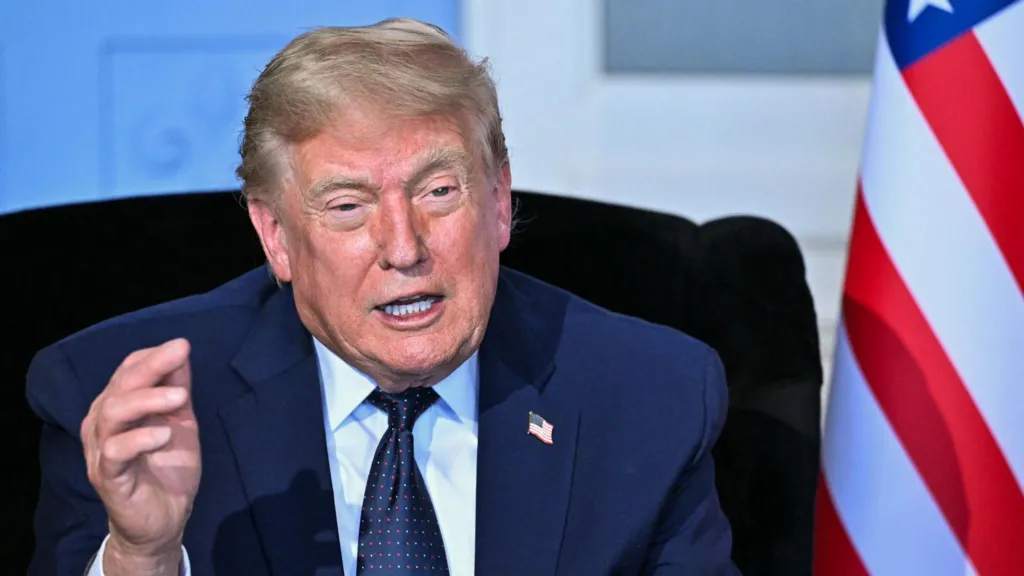
US President Donald Trump may release a preliminary version of the US Iran deal before Friday, according to US Vice-President JD Vance, as senior officials continue to clarify details of the agreement. The comments come after Trump said the deal had already been signed, raising confusion over the status of the framework agreement between Washington and Tehran.
Vance described the US Iran deal as a very general memorandum of understanding, saying it is only about a page and a half long. He explained that the document sets out a broad framework, while many key details will still need to be finalized through technical negotiations between both sides.
Senior US officials have started sharing limited information about the agreement. According to briefings, one of the immediate outcomes of the US Iran deal would be the reopening of the Strait of Hormuz on Friday, the same day the agreement is expected to be formally signed in Geneva. The waterway is one of the most important global routes for oil shipments.
Trump, speaking during meetings at the G7 summit in France, said the agreement had already been signed. He described it as a completed preliminary deal and said he was pleased with the outcome of negotiations. US officials later clarified that the document had been signed electronically by Trump, Vice-President JD Vance, and Iranian Parliament Speaker Mohammad Bagher Ghalibaf.
Despite the announcement, officials stressed that major parts of the US Iran deal are still under negotiation. These include technical discussions on Iran’s nuclear program, verification mechanisms, and the conditions required for any sanctions relief or release of frozen assets.
JD Vance said the agreement creates a general framework under which Iran would receive benefits only if it meets specific obligations. He added that technical teams will now work on detailed rules for compliance and enforcement.
One of the key points outlined in the early version of the US Iran deal is a commitment by Iran to regional peace and stability. According to Vance, this includes stopping support for armed groups that the US considers terrorist organizations. He also said the most important element is Iran’s commitment not to develop a nuclear weapon under a verifiable system.
The agreement also includes a ceasefire extension of 60 days, during which both sides are expected to negotiate the final terms of a longer-term settlement. Officials say this period will be crucial in determining whether the deal can hold or collapse under political pressure.
International attention on the US Iran deal has also increased due to its potential impact on global trade routes. The Strait of Hormuz, which handles a large portion of the world’s oil shipments, is expected to reopen as part of the early implementation steps. This has raised expectations of possible effects on oil prices and energy markets.
The announcement comes as world leaders gather at the G7 summit in France, where Iran is a key topic of discussion. Leaders from Egypt, Qatar, and the United Arab Emirates are also attending a special session focused on regional stability and maritime security.
Military and diplomatic developments in the region remain tense. Israeli Prime Minister Benjamin Netanyahu has said that Israel will maintain security operations in several areas, including Lebanon, Syria, and Gaza, as long as necessary. He also reiterated that Iran must not be allowed to obtain nuclear weapons under any circumstances.
At the same time, reports from Lebanon indicate renewed clashes involving missile and drone attacks, despite the ceasefire framework announced earlier. Officials say the situation remains fragile, even as diplomatic efforts continue.
Iranian officials have presented the agreement as a step toward reducing tensions, while also expressing distrust toward the United States. Iranian military and foreign ministry statements have described the framework as a limited but necessary move to ease pressure, while emphasizing that final outcomes are still uncertain.
Lebanese President Joseph Aoun has welcomed the announcement, saying he hopes it will lead to an end to violence and improved regional stability. However, officials across the region remain cautious as negotiations continue.
The US Iran deal still faces major unresolved issues, particularly around nuclear enrichment limits, international inspections, and the lifting of sanctions. Iran continues to seek access to frozen financial assets and broader economic relief, while the US is pushing for strict verification and enforcement mechanisms.
As discussions move forward, the coming days are expected to determine whether the preliminary agreement can develop into a lasting deal or remain a temporary framework under ongoing political and security uncertainty.

