


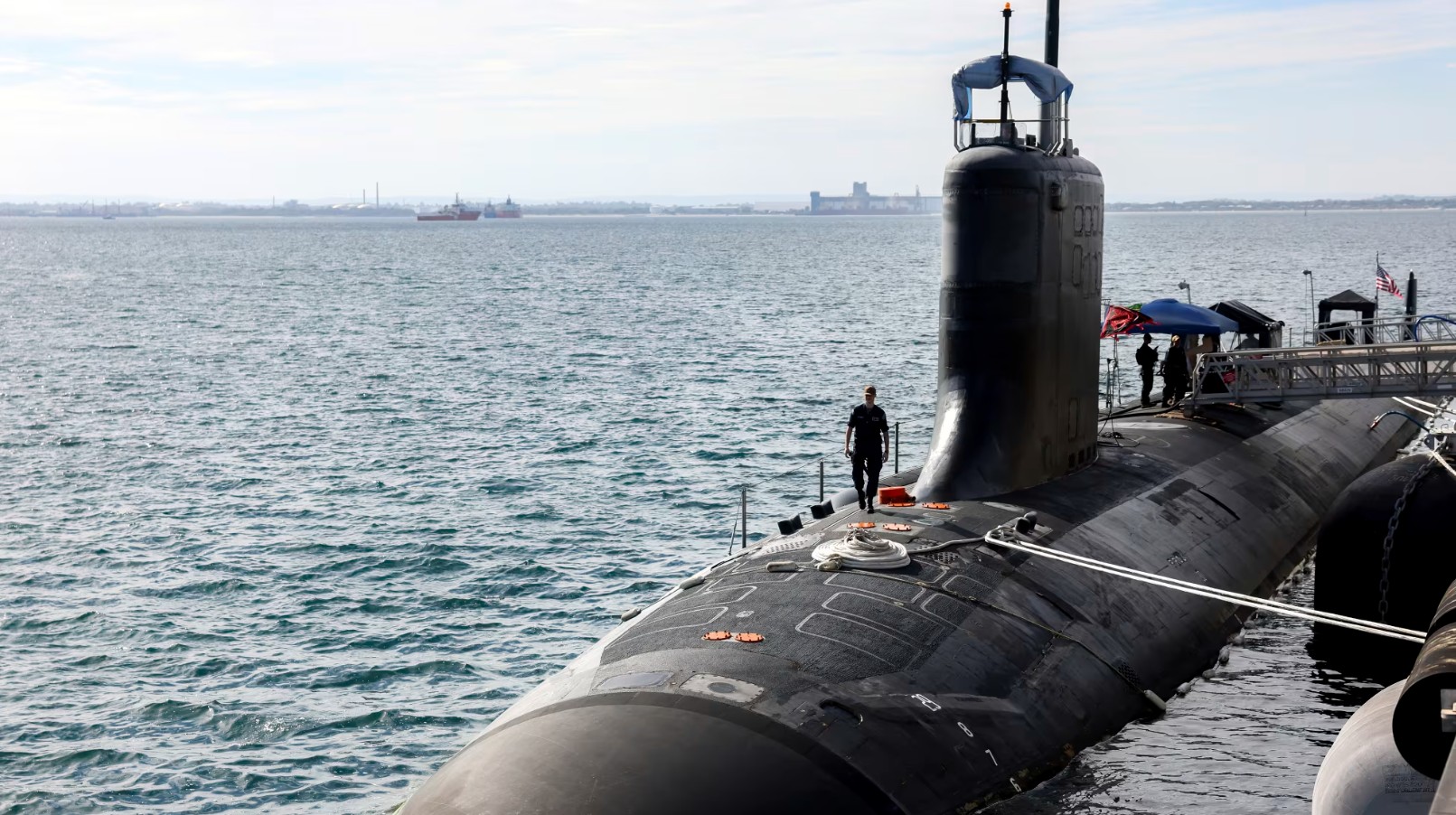
The US Navy is changing its future submarine force in a move that could shape how the United States prepares for a possible conflict with China.
The new US Navy submarine plan will turn 19 planned Virginia class attack submarines into guided missile submarines. The boats will receive a new section called the Virginia Payload Module, or VPM.
The VPM is about 84 feet long. It will add 28 missile launch cells to each submarine. Current versions of the Virginia class have 12 launch cells.
The larger boats will be able to carry more Tomahawk land attack missiles. They will also be able to carry future hypersonic weapons.
The change comes as China continues to expand its military power. The US and China are building forces that could play a major role in any future fight in the Pacific.
Submarines could be important in such a fight because they can move quietly and stay hidden under the sea. This may allow them to operate close to areas where enemy missile and air defenses are strong.
Sidharth Kaushal, a senior fellow at the Royal United Services Institute, said submarines can remain forward in relative safety near or inside the first island chain.
The first island chain runs from Japan through Taiwan and the Philippines. It is seen as a key area in any possible US China military clash.
The new missile submarines could give US forces another way to strike targets without relying only on aircraft or surface ships.
Hypersonic weapons could make this role even more important. These weapons can travel at very high speed and can change their path. That can make them harder to detect and stop.
Launching such weapons from a submarine closer to a target could also reduce the time an enemy has to react.
However, the Navy is making this change as it begins to lose another major source of undersea missile power.
The Navy is starting to retire its four Ohio class guided missile submarines. The four boats were once nuclear ballistic missile submarines. They were later changed into conventional strike platforms.
The Ohio class guided missile submarines can carry up to 154 Tomahawk missiles each. This gives them a much larger missile load than the planned Virginia class boats.
The Ohio class boats have been used for both deterrence and combat missions. They have also supported major US military operations.
During the 2025 US strikes on Iranian nuclear sites, an Ohio class submarine was used to support attacks by B 2 bombers.
The USS Georgia began its deactivation process last month. The Navy plans to retire the other three Ohio class guided missile submarines over the next several years.
This creates a major gap in the number of missiles that US submarines can carry at one time.
The Submarine Industrial Base Council has said the Ohio class retirements could cut the Navy’s undersea strike capacity by up to 60 percent.
The new Virginia class plan is meant to help replace that lost power over time. Yet the replacement will not be equal in missile numbers.
A key difference is that the Virginia class boats are smaller than the Ohio class submarines. Their strength is not only the number of weapons they carry. Their value also comes from their stealth, mobility and ability to operate closer to contested areas.
For US military planners, this could make the new submarines useful in a Pacific conflict where long range missiles and strong defenses would make other operations harder.
The plan also shows how the US Navy is adapting its submarine force to a changing security environment. Instead of relying mainly on a small number of very large missile submarines, the Navy is moving toward a larger group of attack submarines with strong strike power.
That shift could matter greatly around China. It may give US forces more options to strike from the sea while reducing the risk faced by surface ships and aircraft.
At the same time, the new boats will take years to enter service. Their impact will therefore depend on how quickly they are built, how many missiles are available and how the Navy uses them in a wider Pacific strategy.

