


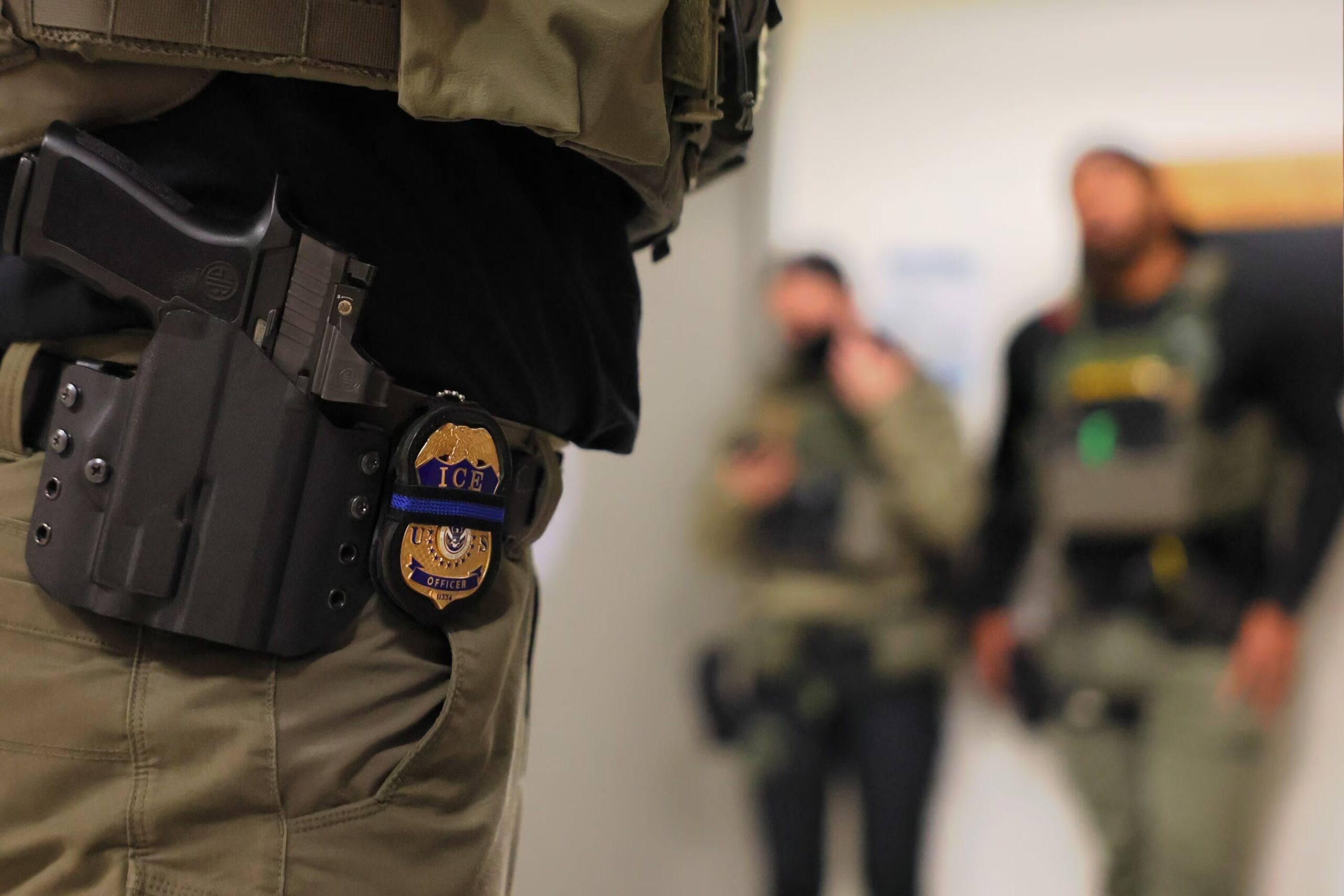
A U.S. Immigration and Customs Enforcement officer has been released from federal custody after appearing in court on charges linked to a shooting investigation in Minnesota.
Christian Castro appeared before a federal judge in McAllen, Texas, on Friday. He is accused of making false statements to investigators about the events that led to the shooting of a Venezuelan man during an immigration enforcement operation earlier this year.
Federal prosecutors allege that Castro provided inaccurate information about the incident when questioned by investigators. According to the indictment, he claimed he was attacked before opening fire during an encounter outside a Minneapolis home in January.
The court hearing was brief. Castro arrived in restraints and appeared before a federal magistrate judge after surrendering to authorities the previous evening.
The judge ordered Castro’s release under several conditions. He must remain under GPS monitoring and was released on a $75,000 unsecured bond. He is also required to appear in court as the case moves forward.
Defense attorneys David A. Lindenmuth and Rolando Cantu told the court that Castro plans to plead not guilty. His next court appearance is scheduled for Sept. 18 in federal court in Minnesota.
The case is significant because it is the first federal prosecution of an officer connected to Operation Metro Surge. That immigration enforcement effort brought thousands of federal agents to the Minneapolis-St. Paul area earlier this year.
The operation led to widespread protests and numerous arrests. It also became the subject of public debate after several violent incidents occurred during enforcement activities.
Federal authorities say Castro’s account of the January shooting does not match evidence gathered during the investigation.
According to the indictment, Castro told an FBI agent that he was attacked by two men while trying to detain another person. He allegedly claimed that one man grabbed a red broom from a front porch and struck him. He also said a second man hit him with a snow shovel.
Castro reportedly told investigators that he fired his weapon while on the ground as the men ran away.
Prosecutors now argue that those statements were false. The indictment alleges that Castro knowingly provided inaccurate information to federal investigators during the review of the shooting.
The shooting injured Julio Cesar Sosa-Celis, a Venezuelan man. He survived the incident.
The federal charges focus on whether Castro misled investigators after the shooting rather than on the act of firing his weapon itself. Prosecutors contend that honesty during a federal investigation is essential and that false statements can interfere with the search for facts.
The federal indictment closely follows charges already filed by Minnesota authorities. State prosecutors have accused Castro of assault and false reporting related to the same incident.
Those state charges were filed after local officials conducted their own review of the shooting. The federal and state cases are moving forward separately.
The investigation has drawn attention because it involves a federal law enforcement officer operating during a large-scale immigration crackdown. Cases involving federal officers are often closely examined due to the public trust placed in law enforcement agencies.
Legal experts note that federal prosecutors must prove that a defendant knowingly and intentionally made false statements. The outcome of the case may depend on witness testimony, physical evidence, and records collected during the investigation.
Supporters of Castro maintain that he acted appropriately under difficult circumstances and should have the opportunity to defend himself in court. His attorneys have indicated that they will challenge the allegations and seek to clear his name.
Federal prosecutors, meanwhile, argue that the evidence supports the charges outlined in the indictment. They are expected to present details of the investigation during future court proceedings.
The case remains in its early stages, and no determination of guilt has been made. Under U.S. law, Castro is presumed innocent unless proven guilty in court.
As the legal process continues, attention will remain focused on both the federal and state cases. The upcoming court appearance in Minnesota is expected to provide a clearer picture of how prosecutors and defense attorneys plan to proceed.
For now, the ICE officer false statements case has entered a new phase, with federal authorities pursuing charges that could have significant legal and professional consequences if proven in court.

