


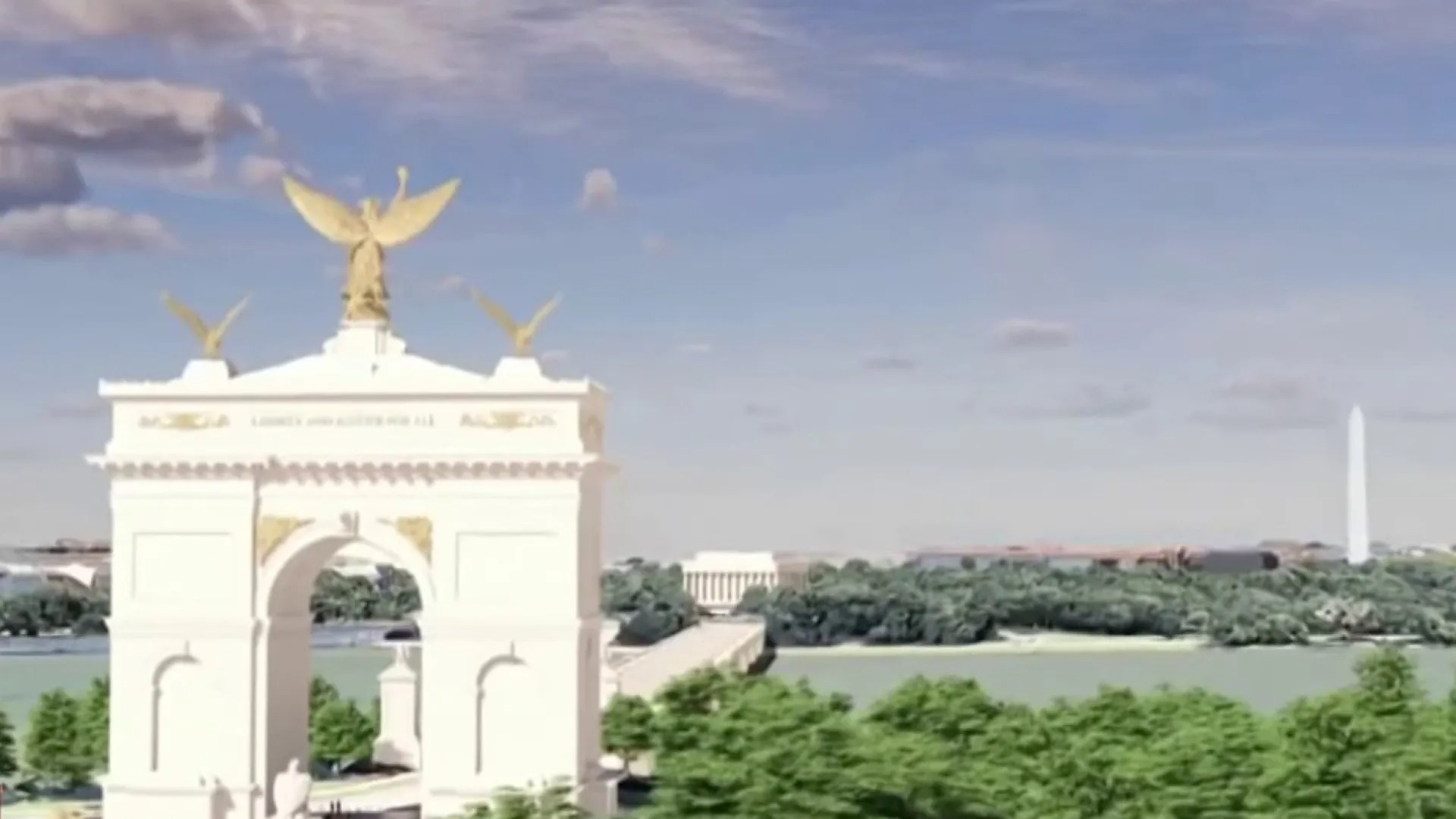
A federal judge has temporarily stopped construction of President Donald Trump’s proposed arch in Washington, DC. The ruling blocks the administration from starting work on the project for 14 days. It came just hours after a federal planning commission approved the design.
US District Court Judge Tanya Chutkan issued the order shortly before midnight on Friday. She granted a request from the governments of Washington, DC, and Virginia. Both had asked the court to stop the project while their legal challenge moves forward.
The proposed structure would stand 250 feet tall at Memorial Circle. The site is a traffic island on the bridge between the Lincoln Memorial and Arlington National Cemetery. The plan has drawn strong criticism from local officials, veterans, lawmakers and historic groups.
In a 33-page ruling, Chutkan examined the reasons given by the Trump administration for building the arch. She paid close attention to the government’s recent claims about national security. She also agreed that construction could cause serious harm to the two local governments.
The judge said the damage could begin as soon as work starts. She pointed to the effect on traffic and daily travel in the area. The project could also bring financial costs and major problems for local services.
The administration had said construction would continue for 20 hours each day throughout the year. Officials expected the work to last between two and three years. DC and Virginia argued that such a large project would disrupt roads, public services and nearby areas.
Chutkan’s order came less than two hours after the National Capital Planning Commission approved the arch in an 8-4 vote. The commission includes members appointed by the president. Its decision marked a key step in the federal review of the project.
The vote followed nearly nine hours of public testimony. More than 130 people had signed up to speak at the virtual meeting. Veterans, family members, lawmakers, experts and local residents shared their views.
The meeting began at 1 p.m. on Thursday. It was held online because of the large number of people who wanted to take part. The live broadcast stopped working just minutes after public comments began. The problem delayed the meeting by about an hour.
Before the meeting, dozens of people gathered at Memorial Circle to protest the plan. They spoke against the proposed arch and raised concerns about its effect on the area.
The site also showed signs of early preparation. White paint marks had appeared on the grass. In a court filing, government lawyers said the lines were placed there by the firm’s chosen for construction. The work appeared to have taken place without approval from the National Park Service.
The legal fight over the arch began earlier this year. A group of Vietnam War veterans and an architectural historian filed a lawsuit against the federal government. They argued that the president cannot build the structure without approval from Congress.
The administration has not received that approval. The lawsuit also raised questions about the legal process used to move the project forward.
The governments of DC and Virginia filed a separate case days before Chutkan issued her order. They raised similar concerns about the legal basis for the project and the harm construction could cause. The judge later combined the two cases.
Chutkan had also told the administration to inform the court within one hour of the planning commission’s decision. This allowed her to review the approval before construction could begin.
The Trump administration had told the court that excavation work could start on the same day as the commission vote. However, the project faced growing legal challenges and had not received approval from Congress.
Opposition to the arch has focused on several issues. Critics say the structure would block an important view near the Lincoln Memorial. They also argue that it would affect the setting of Arlington National Cemetery, where many US service members are buried.
Some veterans said the project would show a lack of respect for those who died in military service. Others raised concerns about the effect of a large structure on the area’s complex airspace. The cost of the project has also remained unclear, as the administration has not confirmed a final figure.
Several speakers said the arch was part of Trump’s effort to leave a lasting mark on the nation’s capital. Some linked the debate to the results of the recent midterm elections. Former DC resident Emi Yamauchi said voters had sent a message against projects driven by personal ambition.
Most speakers at the hearing opposed the plan. Only a small number spoke in its favor. They included Republican Representatives Andrew Clyde of Georgia and Brian Mast of Florida, both of whom are military veterans.
Many comments focused on personal ties to Arlington National Cemetery. Some speakers had family members buried there. Others said they hoped to be buried at the cemetery in the future. They urged commissioners to consider the site’s history before supporting the project.
For now, the judge’s order gives the courts more time to review the legal dispute. The planning commission’s approval remains a separate step in the process. However, the administration cannot carry out construction work during the 14-day pause.
The future of Trump Arch construction will depend on the next steps in court and the legal authority available to the administration.

