


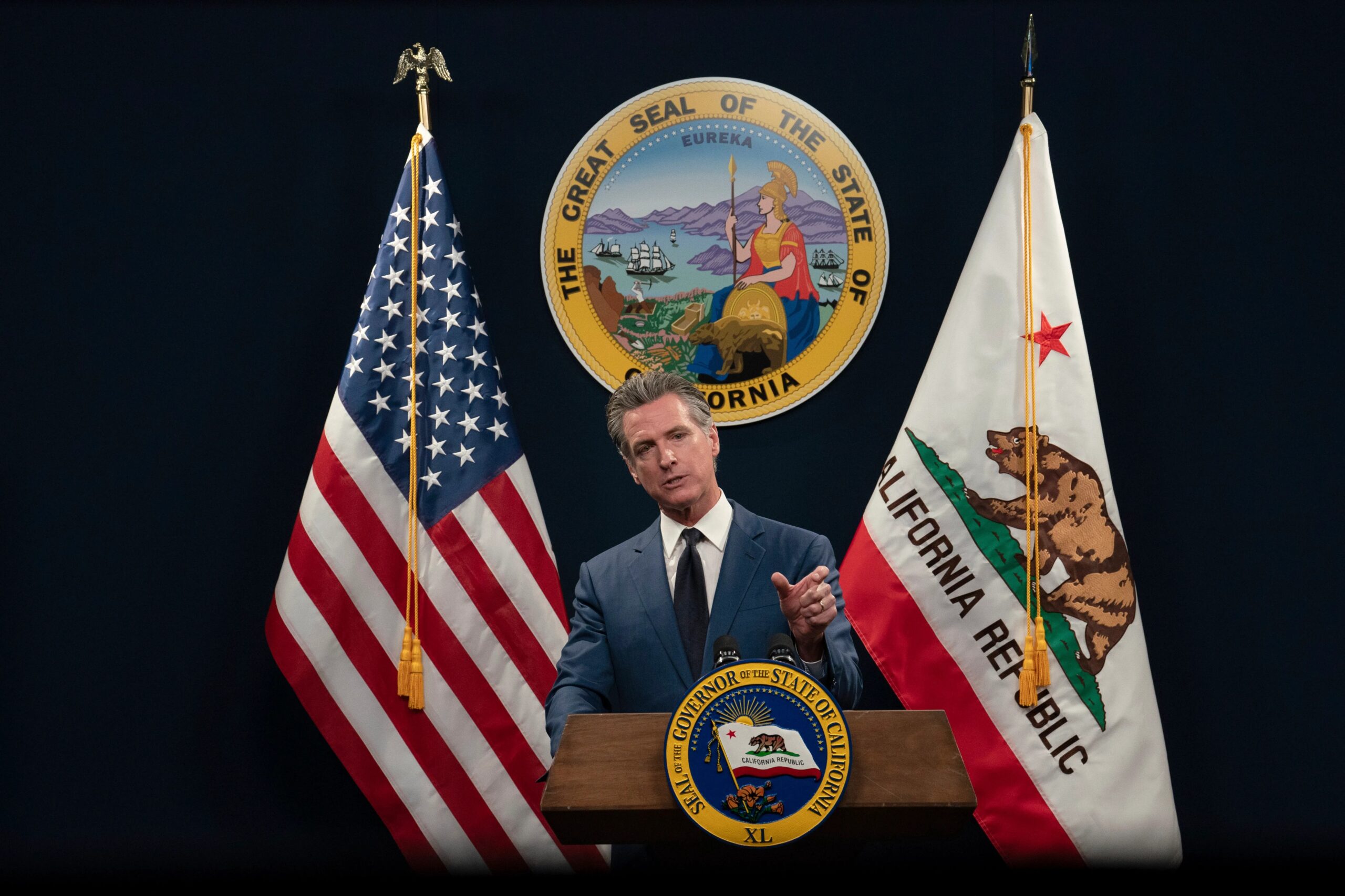
California Governor Gavin Newsom has announced plans to change 548 death sentences in the state to life in prison without the possibility of parole. The decision marks one of the largest actions against capital punishment in US history. However, the California Supreme Court must approve hundreds of the proposed changes before they can take effect.
Newsom announced the decision on Thursday through a public letter. He said the death penalty conflicts with California’s values and weakens the justice system. He also said the government should not take the lives of people under its authority.
“I take this action because I firmly believe that state-sanctioned killing is incompatible with California’s values,” Newsom wrote. He added that capital punishment harms the foundations of the legal system.
The governor’s plan covers 548 people currently on California’s death row. They include 529 men and 19 women, according to figures from his office. If approved, their sentences would change to life in prison without any chance of release.
However, the process faces a legal requirement. California’s constitution says the state Supreme Court must approve clemency for people who have been convicted of a felony more than once.
This rule applies to 382 of the 548 prisoners included in Newsom’s plan. That represents about 70% of the total. Newsom has already sent a formal request to the court asking for approval.
The Death Penalty Information Center said the move would represent the largest mass clemency action in American history. If all the requests receive approval, the number of people on death row across the United States would fall by nearly 30%.
The announcement comes as Newsom prepares to leave office after serving eight years as governor. He has long opposed the death penalty. In 2019, he introduced a moratorium that stopped executions in California. No execution has taken place in the state since 2006.
Newsom said his latest decision followed years of thinking about the limits of government power. He also described it as one of the hardest choices of his political career. He acknowledged that the move could bring back painful memories for families who lost loved ones to violent crimes.
California has the largest death row in the Western Hemisphere. Voters supported keeping the death penalty through ballot measures in 2012 and 2016. The issue remains deeply divisive across the country. Nearly half of US states have ended capital punishment, while others continue to carry out executions.
Several well-known convicted killers remain on California’s death row. They include Richard Allen Davis, who kidnapped and murdered 12-year-old Polly Klaas in 1993. Another is Randy Kraft, known as the Scorecard Killer, who kept a list of victims during the 1970s and 1980s.
Some other high-profile prisoners, including Scott Peterson and members of the Manson family, previously received death sentences that were later changed to life in prison.
Jess Nichol, the sister of Polly Klaas, said her views on the death penalty had changed over time. She once believed Davis should be executed. However, she now questions whether executions help families recover from such losses.
Nichol said the justice system often tells victims’ families that executions will help them heal. She disagreed with that view and said families need other forms of support.
The American Civil Liberties Union welcomed Newsom’s announcement. The group has long argued that the death penalty is unfair and affected by racial bias. Its executive director, Anthony Romero, said the commutations reflected the need to end a punishment that can lead to serious mistakes.
The ACLU is also involved in a legal case challenging California’s death penalty law. The group argues that the system is racially discriminatory and violates constitutional rights.
However, the decision has faced strong criticism from victims’ families and prosecutors. Patricia Wenskunas, founder of the Crime Survivors advocacy group, said the move was offensive and deeply upsetting. Her organization has opposed efforts to end capital punishment.
Steve Herr, whose son Sam was murdered in 2010 alongside his friend Julie Kibuishi, also condemned the decision. Daniel Wozniak was convicted of the killings. Herr said he believed the execution of his son’s killer would have brought closure to the family.
The California District Attorneys Association also criticized Newsom. Its president, Jeannine M. Pacioni, said the decision ignored the work of juries and judges. She added that families who lost loved ones had not been given a choice in the matter.
San Luis Obispo County District Attorney Dan Dow called the move an abuse of power. He pointed to the murders of Rachel Newhouse, Aundria Crawford and Kesha Gurke. Dow said the families had waited for decades for the state to carry out the sentences.
Orange County District Attorney Todd Spitzer also spoke against the decision. He argued that changing the sentences would place the needs of convicted killers above those of their victims.
Newsom is not the first governor to take such action. Oregon Governor Kate Brown changed death sentences in 2022, while Colorado Governor Jared Polis did the same in 2020. In 2024, former President Joe Biden also granted clemency to 37 of the 40 people on federal death row.
Xavier Becerra, who is set to replace Newsom in January, has said he will continue California’s moratorium on executions. However, the future of the latest commutation plan now depends on the state Supreme Court’s decision.

