


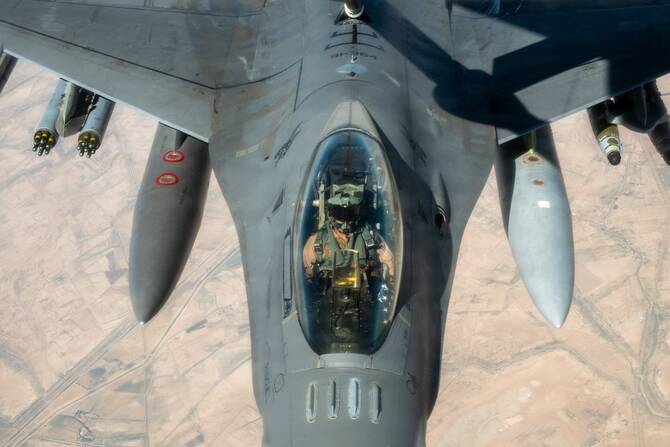
The United States launched another round of military strikes against Iran on Saturday after both countries exchanged fresh attacks following a new dispute over the Strait of Hormuz. The latest fighting has raised concerns that recent efforts to reduce tensions could quickly collapse.
The renewed conflict comes only one week after both sides signed a memorandum of understanding aimed at ending military operations and restoring stability in the region. However, the agreement came under pressure after a commercial ship was attacked while passing through the Strait of Hormuz on Thursday.
According to U.S. officials, Iran launched several drones toward ships traveling through the vital waterway. One drone struck the Singapore-flagged cargo vessel M/V Ever Lovely, causing damage to the ship’s upper deck. Officials said no crew members were injured, and the vessel remained able to continue its journey.
The United States responded on Friday with airstrikes against Iranian military targets. The Pentagon said the operation was a direct response to what it described as Iran’s attack on commercial shipping and a violation of the ceasefire agreement.
American officials said Iran was given an opportunity to return to the terms of the agreement but instead continued military actions. On Saturday evening, U.S. Central Command launched another series of strikes against multiple targets inside Iran under orders from President Donald Trump.
President Trump said U.S. aircraft attacked missile storage sites, drone facilities, and coastal radar systems. He stated that the strikes were carried out because Iran had violated the ceasefire agreement. The president also warned that the United States would take additional military action if Iran continued its attacks.
Iran later confirmed that it had launched ballistic missiles and drones against eight infrastructure targets linked to U.S. military bases in Kuwait and Bahrain. Iranian military officials said the attacks were carried out in response to American airstrikes.
Bahrain strongly condemned the reported drone attack on its territory. The Gulf nation described the incident as a serious violation of its sovereignty and a threat to the safety of its citizens and residents. Bahrain is home to the U.S. Navy’s Fifth Fleet, making it an important military location in the region.
Iran also warned that stronger action could follow. Military officials said vessels using routes outside those approved by Tehran could face increased risks in the future. Iranian forces have argued that navigation through the Strait of Hormuz should follow routes set by Iranian authorities.
The Strait of Hormuz remains one of the world’s most important shipping lanes. Around one-fifth of global oil supplies passed through the waterway before the recent conflict. Any disruption in the area can quickly affect global energy markets and international trade.
The memorandum of understanding signed last week was intended to reopen the Strait of Hormuz and allow commercial vessels to travel safely for at least 60 days without additional charges. The agreement also aimed to reduce military operations across several areas of the region.
However, both sides now accuse each other of breaking the agreement. Iranian officials said the United States violated the deal by carrying out airstrikes while negotiations were still continuing. American officials argued that Iran’s attacks on commercial shipping triggered the military response.
Regional tensions have also spread beyond the Gulf. Limited fighting has continued between Israeli forces and the Iran-backed Hezbollah group in southern Lebanon despite separate diplomatic efforts to reduce violence. This has added further pressure to an already unstable security situation.
Maritime security agencies have responded by increasing warning levels for ships traveling through the Strait of Hormuz. Authorities advised vessels to remain alert because of possible naval operations and the continuing risk of mines and drone attacks.
Shipping companies are closely monitoring the situation as any further disruption could delay global trade and increase transport costs. Energy markets are also watching developments because the Strait of Hormuz is a key route for oil exports from the Gulf region.
The latest exchange of military action has increased fears that the ceasefire agreement may fail completely. Diplomatic efforts continue, but ongoing strikes and rising tensions suggest that the security situation in the Gulf remains highly uncertain.

