


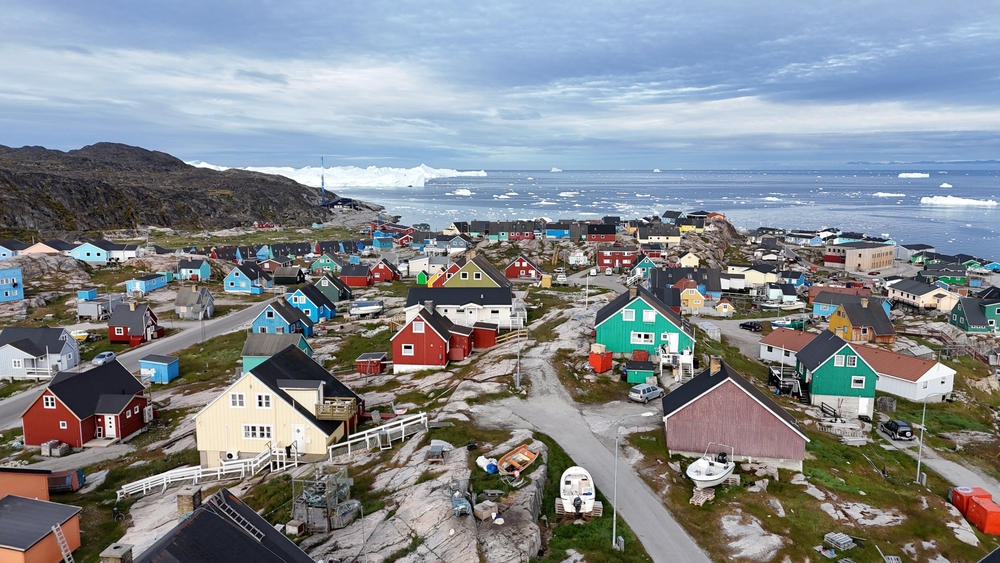
Greenland, the world’s largest island, has become a focal point of international attention after the Trump administration signaled that the use of military force remains “an option” in pursuing U.S. influence over the Arctic territory. The island’s location and resources make it a strategic prize for global powers.
Situated off Canada’s northeastern coast, more than two-thirds of Greenland lies within the Arctic Circle, giving it critical importance for North American defense, missile monitoring, and naval operations through the GIUK Gap—a key corridor for NATO surveillance of Russian movements.
U.S. Signals Interest in Greenland
White House press secretary Karoline Leavitt said Tuesday that Trump considers acquiring Greenland a national security priority. “It’s vital to deter our adversaries in the Arctic region,” she said. “The president and his team are discussing a range of options to pursue this important foreign policy goal, and of course, utilizing the U.S. military is always an option at the commander in chief’s disposal.”
Trump first floated the idea of purchasing Greenland during his first term but renewed interest after a recent U.S. operation in Venezuela that removed President Nicolás Maduro. Trump argued the U.S. needs control over Greenland to counter growing Russian and Chinese activity in the Arctic.
Despite the rhetoric, some officials have downplayed the likelihood of military intervention. Special envoy to Greenland Jeff Landry and Deputy Chief of Staff Stephen Miller indicated that a military approach is unnecessary, and Republican House Speaker Mike Johnson said, “No. I don’t think it’s appropriate.”
International Pushback
Trump’s renewed interest drew swift international criticism. Leaders from Denmark, France, Germany, Italy, Poland, Spain, and the U.K. issued a statement defending Greenland’s sovereignty. “Greenland belongs to its people,” they said, emphasizing that decisions about the island’s future rest with Denmark and Greenland alone.
Canada also voiced support for Denmark, with Prime Minister Mark Carney announcing a visit to Greenland next month by Governor General Mary Simon, of Inuit descent, and Foreign Minister Anita Anand. “The future of Greenland and Denmark are decided solely by the people of Denmark,” Carney said.
Landry, however, has expressed a desire to engage directly with Greenlanders rather than Danish or European officials, saying he wants to discuss ways to improve local quality of life. He has already exchanged emails with residents and jokingly compared Greenlanders’ outdoor lifestyle to Louisiana’s hunting and fishing culture.
Greenland’s Strategic and Economic Significance
Greenland has been a Danish territory for centuries, formally integrated in 1953, and gained expanded self-rule in 2009, including a legal right to pursue independence. Its strategic importance to the U.S. and NATO is long-standing: the Pituffik Space Base in northwestern Greenland, built under a 1951 defense agreement with Denmark, supports missile warning, missile defense, and space surveillance.
The island also sits atop vast natural resources, including rare earth minerals critical for electronics and renewable energy, as well as potential offshore oil and gas deposits. Its location, infrastructure, and resources make Greenland a central piece in Arctic security and global resource competition.
While Greenlanders have shown little interest in joining the U.S., the island’s strategic and economic value ensures it will remain a point of contention in international geopolitics.

