


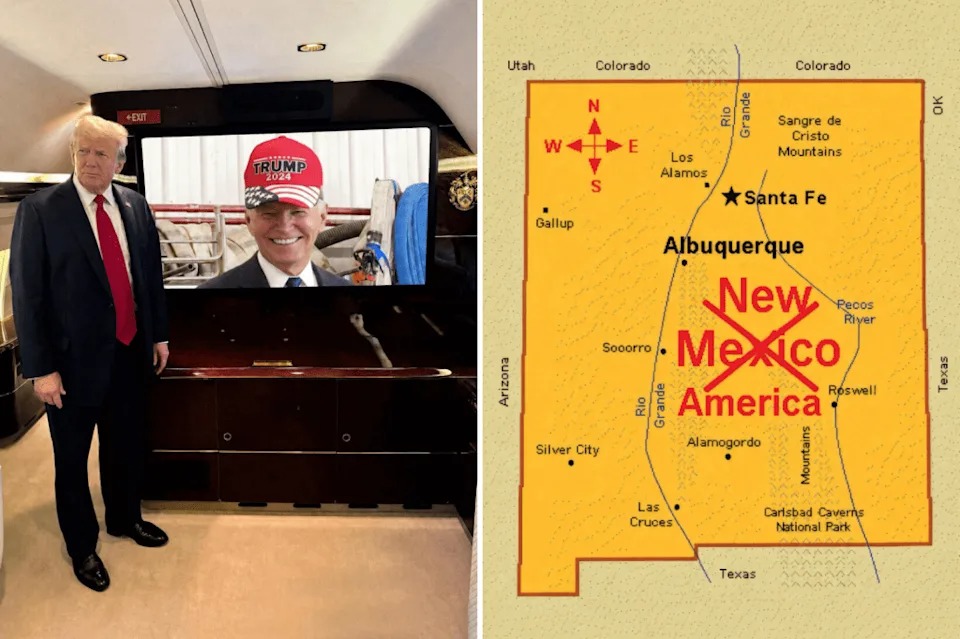
President Donald Trump sparked a new political debate on Sunday after sharing an image that appeared to suggest New Mexico should be renamed “New America.”
The image was posted on his social media platform and later shared by the White House on another social media site. It showed the outline of New Mexico with the word “Mexico” crossed out in red. The word “America” was written in its place. No explanation was given with the image.
The post quickly drew attention across the country. Many people questioned whether the administration was considering a formal effort to rename the state. However, no official announcement has been made, and the White House has not said that any such plan exists.
The image appeared just days after Trump signed an executive order that changed the name of Lake Ontario to “Lake America” in the federal geographic naming system. The move followed an earlier order issued in January 2025 that renamed the Gulf of Mexico as the Gulf of America.
Those actions have highlighted Trump’s interest in changing the names of major geographic locations. Supporters say the changes promote national pride. Critics argue that they create unnecessary controversy and distract from more pressing issues.
Experts note that renaming a state is very different from renaming a body of water or a federal landmark. A president can direct changes to names used in federal systems for certain geographic features. However, the United States Constitution does not give the president the power to rename a state.
Any effort to change a state’s name would need to take place through legal and political processes within that state. As a result, Trump cannot simply order New Mexico to be renamed.
New Mexico Governor Michelle Lujan Grisham strongly criticized the post. The Democratic governor said the state’s name is not open for debate and accused the president of trying to shift attention away from other national issues.
In a statement shared on social media, she said New Mexico was focused on serving residents while the White House spent time discussing maps and names. She also pointed to concerns about rising gas prices and foreign policy challenges.
Democratic Senator Martin Heinrich of New Mexico also responded. He rejected the idea of changing the state’s name and said he would continue to use the traditional names of New Mexico, the Gulf of Mexico, and Lake Ontario.
The debate also renewed interest in the history of New Mexico’s name. Historical records show that the name dates back to the 16th century, long before the United States became an independent nation. The name has deep roots in the region’s history and culture.
For many residents, the name reflects centuries of heritage and identity. It is tied to Native American, Hispanic, and early colonial history that shaped the region long before modern state boundaries were established.
Trump has often used symbolic actions and public statements to highlight his authority as president. Renaming landmarks has become one of the most visible examples of that approach during his current term in office.
The president’s recent decision to rename Lake Ontario came during a period of trade tensions with Canada. The move attracted attention on both sides of the border and led to debate among political leaders and historians.
Trump has also suggested that more name changes could be considered in the future. Shortly after signing the order involving Lake Ontario, he joked about the possibility of renaming one or both of the oceans that border the United States.
He noted that the country now had a gulf and a lake carrying the America name and suggested that an ocean could be next. While the remark appeared lighthearted, it reinforced his interest in using geographic names as a symbol of national identity.
For now, New Mexico remains unchanged. Still, Trump’s latest post has sparked a fresh political dispute and renewed discussion about history, identity, and the limits of presidential power.

