


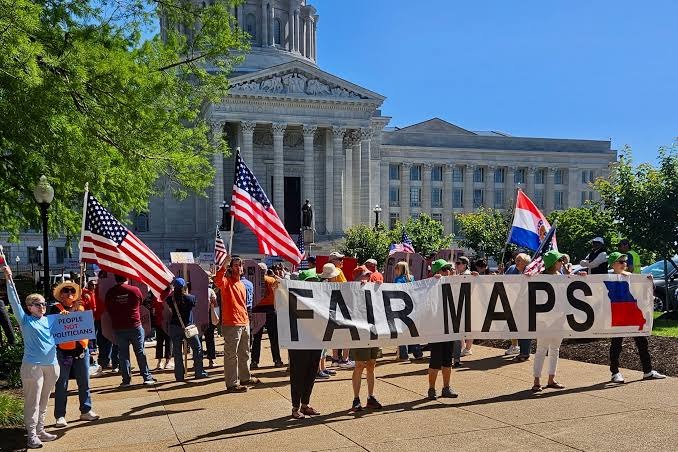
A legal fight over Missouri’s congressional district map has created fresh uncertainty ahead of the November election. Conflicting rulings from state and federal courts on Tuesday left election officials racing to determine which district boundaries should be used as critical ballot deadlines approach.
The dispute centers on a Republican-backed redistricting plan that is expected to improve the party’s chances of gaining another seat in the U.S. House of Representatives. While an effort to restore the plan faced a setback at the nation’s highest court, a federal ruling issued shortly afterward gave new momentum to supporters of the map.
Justice Brett Kavanaugh rejected an emergency appeal from Republicans seeking to block a recent Missouri Supreme Court decision. That state ruling restored older district boundaries and directed that voters decide in November whether the newer redistricting plan should be used in future elections.
Kavanaugh’s decision appeared to leave the state court ruling in place. He did not provide a written explanation and did not indicate that the issue had been referred to the full Supreme Court. Such emergency decisions are often handled by the justice assigned to a specific federal circuit, and Kavanaugh oversees matters arising from Missouri’s region.
Minutes after that decision became public, however, Chief U.S. District Judge Stephen Clark issued a temporary restraining order that effectively paused the state court’s action. Clark ruled that Missouri officials should continue using the congressional map already used during the state’s primary elections in August.
The federal ruling marked a significant victory for Republican supporters of the map. Political observers believe the districts could help Republicans gain an additional House seat in Missouri, where two congressional districts are currently represented by Democrats.
Democratic groups quickly challenged the federal decision. The organization leading the effort against the redistricting plan filed an appeal with the 8th U.S. Circuit Court of Appeals and requested emergency action to stop Clark’s order while the appeal is reviewed.
The group also asked Clark to suspend his ruling and requested that Missouri’s Supreme Court hold Secretary of State Denny Hoskins in contempt. Democrats argue that state officials should follow the state court’s decision rather than the federal order.
The conflicting decisions have added confusion to an election process already under pressure. Local election officials have spent months preparing for both possible outcomes as court battles continued. Because of the ongoing legal uncertainty, many counties developed separate plans depending on which district map ultimately survived court review.
Timing has become a major concern. The court actions arrived just hours before an important deadline for election officials to make changes to ballots. State authorities must finalize ballot designs before absentee and mail ballots begin going out to voters later this month.
Following the federal ruling, Hoskins instructed election officials to prepare for the November election using the map employed during the August primaries. That guidance was sent shortly after Clark’s decision and signaled that state officials intended to move forward under the newer district boundaries unless another court intervenes.
Supporters of the federal ruling argue that changing district lines after primary elections have already been completed would create confusion and raise constitutional concerns. Clark agreed that the Republican candidates who filed the lawsuit were likely to succeed in arguments that altering district boundaries now could violate constitutional protections.
State officials also warned that switching maps at this stage could create major administrative problems. They pointed to the fact that candidates and voters already participated in primary elections under the newer district lines.
Democrats strongly disagree. They argue that any disruption to election administration resulted from decisions made by Republican leaders and state officials. They maintain that voters should have the opportunity to weigh in on the redistricting plan and that the state court’s decision should be respected.
The dispute has also drawn national attention. President Donald Trump criticized the Missouri Supreme Court’s ruling and expressed support for using the district map that was in effect during the primary elections.
With appeals now moving through multiple courts, election officials, candidates, and voters remain in a state of uncertainty. The final outcome could influence not only Missouri’s congressional representation but also control of closely contested seats in the U.S. House. As legal challenges continue, all sides are watching closely for the next ruling that may determine which map is ultimately used in November.

