


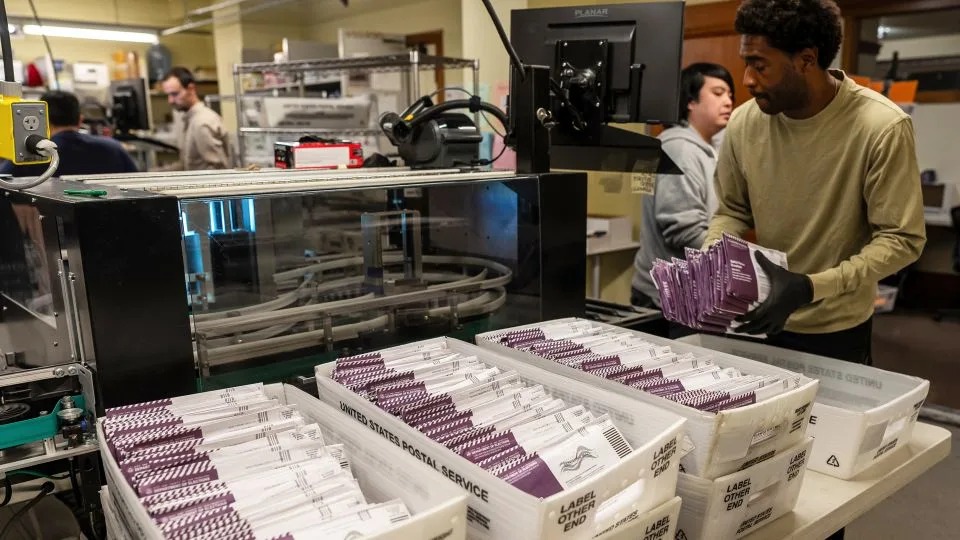
A federal appeals court has rejected the Trump administration’s attempt to block the counting of more than 20,000 mail-in ballots in California. The government claimed that the votes could belong to people who are not US citizens.
The ruling marks a setback for the Justice Department. It is seeking a greater role for the federal government in how states manage elections.
On Monday, a three-judge panel of the 9th US Circuit Court of Appeals rejected the department’s emergency appeal in a 2-1 decision. The ruling followed a rare Sunday hearing held online.
Judge Mark Bennett, who was appointed by President Donald Trump, and Judge Gabriel Sanchez, appointed by former President Joe Biden, formed the majority. They ruled that the appeals court could not decide the case before the lower court had addressed the issue.
The judges also questioned the government’s claim that the matter needed urgent action. They said the Justice Department had played a role in creating the delay.
“The United States’s claimed emergency, at least in part, is a self-constructed one,” the majority wrote.
The judges pointed to delays in filing the lawsuit and in understanding California’s election rules. They also noted that the state has millions of registered voters and follows set steps to process ballots.
The court’s ruling sends the case back to a federal district court in California. A hearing is set for Tuesday at 4 p.m. Eastern Time.
The Justice Department filed its lawsuit earlier this month. It asked the court to stop California officials from counting more than 20,000 mail-in ballots linked to people the federal government believes may not be citizens.
The department said the voters could be ineligible to vote in federal elections. However, the state and Los Angeles County challenged the government’s claims and the way it had identified the voters.
After the district court did not issue a ruling last week, the Justice Department asked the appeals court to step in before the scheduled hearing. The appeals court declined to do so.
The judges did not issue a final ruling on whether the ballots could be counted. Their decision focused on whether the appeals court could act before the lower court had ruled on the case.
Still, two judges expressed strong doubts about the Justice Department’s legal arguments during Sunday’s hearing.
Bennett wrote in a separate opinion that he would have ruled against the federal government if the appeals court had been allowed to decide the full case at that stage.
He said the federal law cited by the Justice Department did not take away the states’ main role in running elections.
Bennett also warned that the government’s request could cause serious problems for election officials and voters. Blocking the ballots, he said, could prevent eligible citizens from having their votes counted and put the wider vote-counting process at risk.
He stressed that California still has the duty to set rules for congressional elections and handle challenges to ballots under state law.
Judge Patrick Bumatay, another Trump appointee, disagreed with the majority and issued a dissenting opinion.
California officials and Los Angeles County argued that the Constitution gives states the main role in running elections, subject to the powers granted to Congress. They also said the federal government’s list of suspected noncitizen voters relied on data that could not be trusted.
The state said the list arrived while the election process was already underway. Changing the rules at that stage, officials argued, could disrupt voting and create confusion.
California Attorney General Rob Bonta welcomed the appeals court’s decision on Monday.
“The court’s order serves as an important step in our efforts to protect Californians’ right to vote and our state’s authority to run fair and secure elections,” Bonta said.
During Sunday’s hearing, Bennett asked why a federal court should overturn California’s election procedures. He noted that the Constitution gives states a central role in managing elections, along with Congress.
He questioned how the court could issue an order that conflicted with rules adopted by the California legislature.
Sanchez also warned that the Justice Department’s request could change election rules while voting was still underway. He said this could confuse voters, take staff away from other election duties, and disrupt the counting process.
In his separate opinion, Sanchez said the government was asking a federal court to change a matter that has long been handled by states. He warned that such action could lead to disorder for both voters and election officials.
Sanchez also questioned how the Justice Department and the Department of Homeland Security created the list of more than 20,000 voters.
He pointed to sworn statements from two Homeland Security officials. The statements referred to third-party data and reliable third-party analysis but did not clearly explain the sources.
Sanchez pressed the Justice Department’s lawyer, Matthew Donnelly, to explain what those terms meant and how the data supported the government’s claims.
The next hearing in the district court will allow the judge to examine the dispute in greater detail. Until then, the appeals court’s decision leaves the case to proceed through the normal legal process.
The dispute raises key questions about state control of elections, federal power, and the use of voter data. The court’s next steps will help determine how the challenge to California’s mail-in ballots moves forward.

