


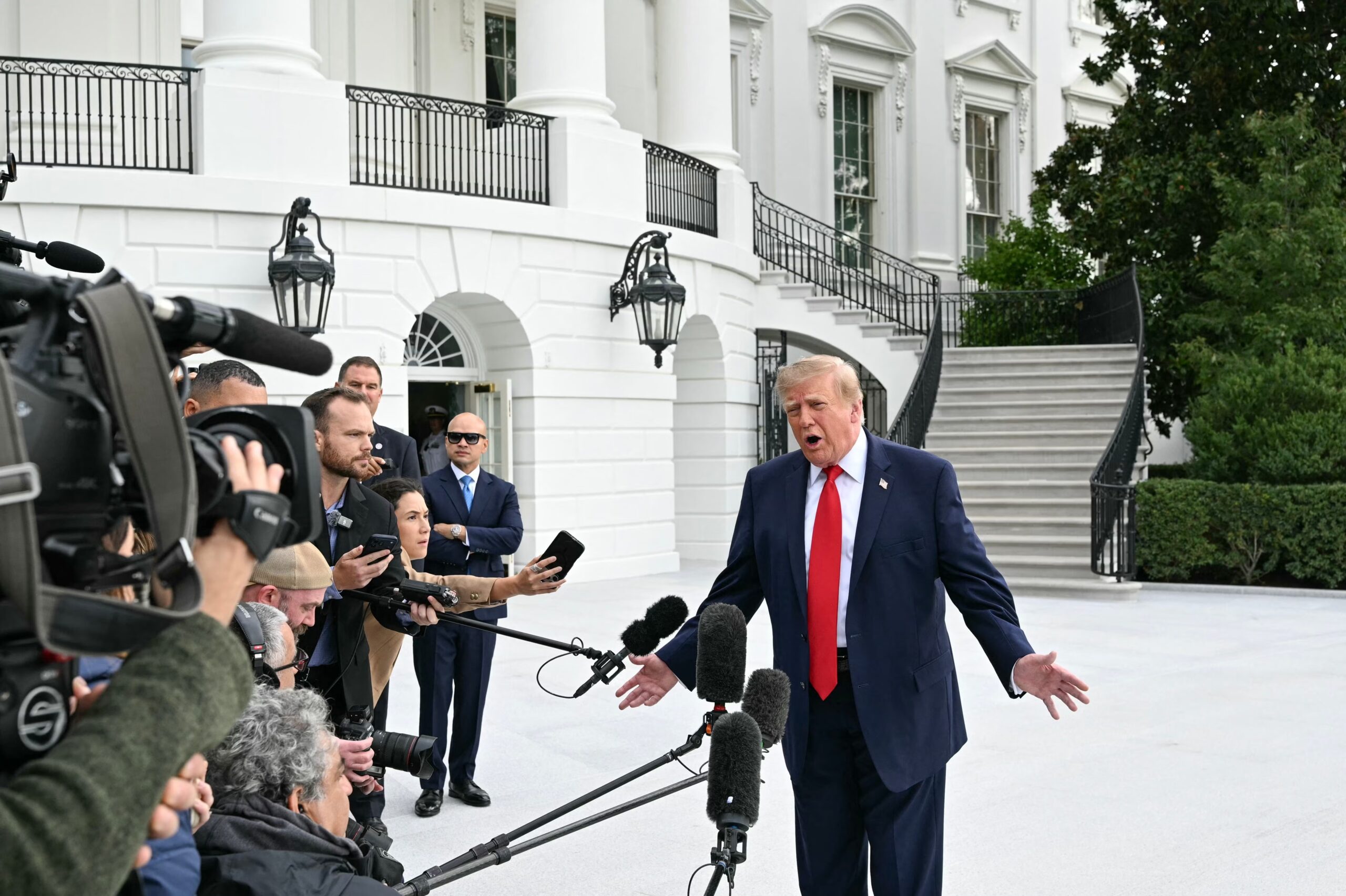
The dispute over media access at the White House grew stronger on Saturday as President Donald Trump defended his administration’s decision to restrict some major news outlets from participating in the presidential press pool.
The latest clash came as Trump departed the White House for a trip to Knoxville, Tennessee. During a brief exchange with reporters, he faced questions from Akayla Gardner, a White House correspondent for MS Now, about the administration’s handling of press access.
Gardner asked Trump whether he only wanted news organizations that support him to be included in the press pool. Trump rejected that claim and responded by saying he wanted what he described as “real news.” He then criticized both MS Now and CNN, two networks that have frequently faced criticism from the president.
As the conversation continued, Gardner asked whether Trump was unwilling to face difficult questions from reporters. Trump responded by telling her to “be quiet” before continuing his criticism of media coverage that he believes is unfair to his administration.
The exchange added to a growing conflict between the White House and several major news organizations. Trump has long argued that some media outlets provide coverage that is overly negative and inaccurate. Throughout his political career, he has often labeled unfavorable reporting as “fake news” and accused certain organizations of political bias.
The issue gained fresh attention after the White House recently moved to limit access for several media outlets. Administration officials revoked White House credentials for MS Now, CNN, and Politico following Trump’s announcement of a new policy affecting press access.
The decision quickly sparked legal and political debate. Supporters of the affected organizations argued that the restrictions raised concerns about press freedom and equal access to government events. Critics of the administration said the move could make it harder for independent journalists to report on presidential activities.
A federal judge later issued a temporary order restoring access for the outlets. However, tensions remained high. Reporters and producers from some of the affected organizations were still unable to attend a state dinner held in honor of Chinese President Xi Jinping later that week.
The dispute expanded again when the White House changed travel coverage arrangements for presidential trips. CNN had originally been scheduled to provide television pool coverage during Trump’s visit to Tennessee. Pool coverage allows one network to gather video and information that can be shared with other news organizations.
Instead, another network was selected to accompany the president on the trip. The change drew attention because pool coverage plays a key role in ensuring broad access to presidential events, especially when space is limited.
During his visit to Knoxville, Trump attended a college football game and appeared before a large crowd. Video clips from the event were later shared online, showing the president’s image displayed on the stadium’s giant screen.
After returning to Washington, Trump did not take questions from print reporters who had traveled with him. The lack of a formal question-and-answer session left several issues unresolved and continued debate over the administration’s relationship with the press.
Media observers say the conflict reflects a broader struggle over how presidential coverage is managed and who gets access to important government events. Many journalism groups have argued that a free and independent press is essential for public accountability. They maintain that reporters should be allowed to ask difficult questions regardless of whether coverage is favorable to government officials.
The White House, meanwhile, has defended its actions and said it wants accurate reporting from organizations covering the president. Administration officials argue that media outlets should be held accountable when they publish information that the White House believes is misleading or incorrect.
As legal challenges and public debate continue, the disagreement over media access remains one of the most closely watched issues surrounding the administration. The outcome could shape future rules governing how journalists cover the White House and report on presidential activities in the years ahead.

