


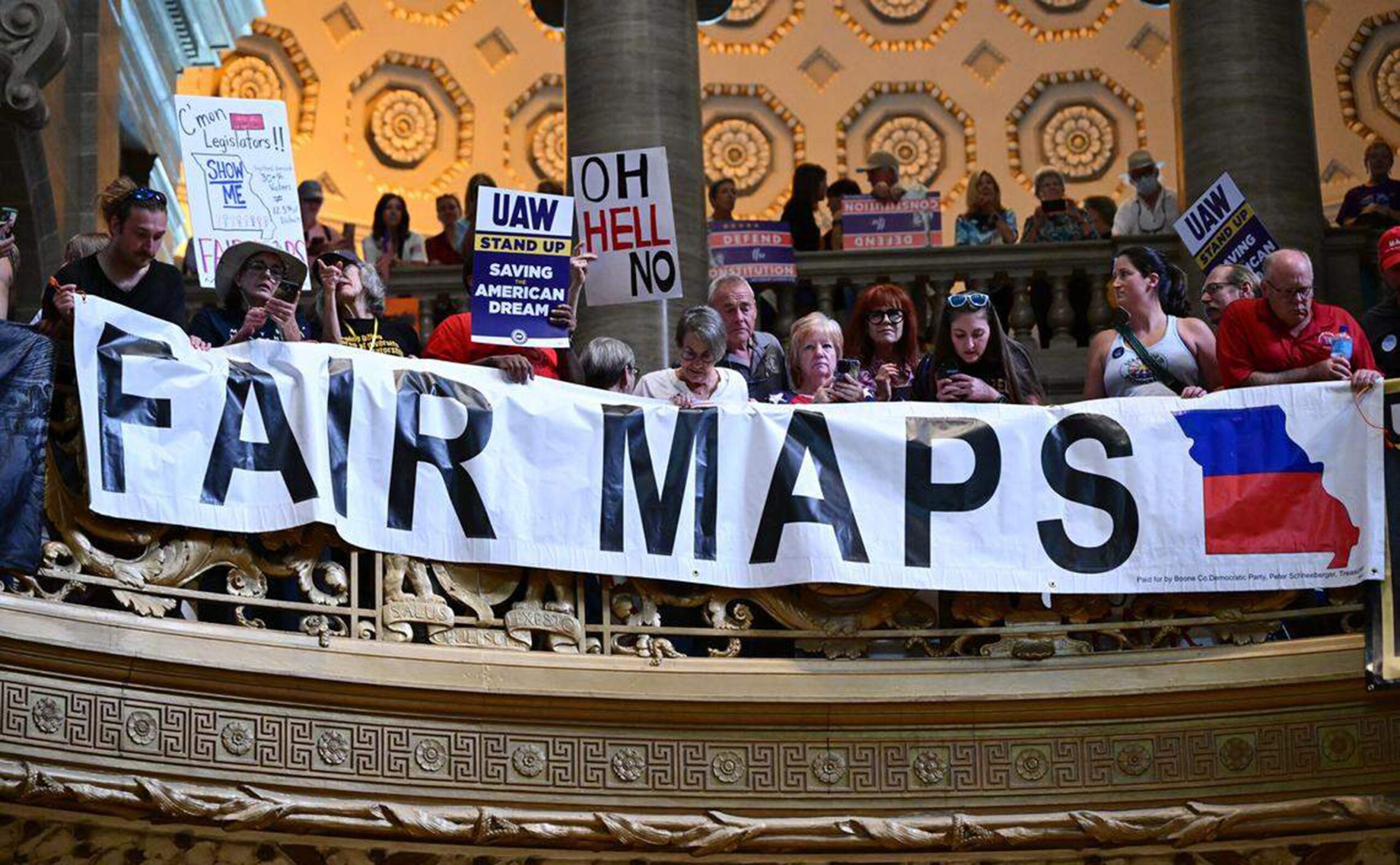
President Donald Trump criticized the U.S. Supreme Court on Sunday after it blocked a Republican-backed congressional map in Missouri for a third time, keeping a long-running election dispute in the national spotlight.
In a post on Truth Social, Trump argued that the court’s decision prevented Missouri from using a congressional map favored by Republicans. He praised state leaders and supporters who backed the effort and said they were fighting for what they viewed as fairness and election security.
Trump also highlighted his past election victories in Missouri. He said he remained proud of the support he received from voters in the state during his presidential campaigns.
The latest dispute centers on which congressional district map Missouri will use in the upcoming general election. On Friday, the Supreme Court stopped state officials from moving forward with a Republican-supported map, requiring them to return to an older version for the election.
The ruling marked the third time the nation’s highest court has intervened in the legal battle over Missouri’s congressional boundaries.
Republican lawmakers had pushed for a map that would likely provide their party with a stronger advantage in the state’s congressional delegation. Supporters of the plan argued that the map reflected lawful redistricting decisions approved through the legislative process.
Under the newer map, Republicans hoped to secure a congressional delegation with a potential 7-1 partisan split. The older map, which Missouri must now use for the general election, has been viewed as producing a possible 6-2 split.
The disagreement over district boundaries has led to several rounds of legal challenges and court reviews. The issue returned to the Supreme Court again after lower courts issued conflicting decisions on the validity of the revised map.
Missouri Republicans approved the newer congressional map last year. State officials then used those district boundaries during primary elections held last month.
However, legal challenges continued after the primaries. Opponents of the map argued that election officials should not proceed with the new boundaries while questions about their legality remained unresolved.
The Supreme Court’s latest action means Missouri will use different congressional lines in the general election than the ones used during the primary contests. The change creates a rare situation in which voters and candidates could face different district boundaries between stages of the same election cycle.
The legal dispute gained new attention earlier in the week when the case returned to the Supreme Court for another review. Previous rulings from the court had also gone against the Republican-backed map, though those earlier decisions were considered temporary or procedural.
Before the Supreme Court’s latest action, the 8th U.S. Circuit Court of Appeals had issued a final ruling supporting the Republican position. The appeals court said it would be unconstitutional to require election officials to return to the older map after primary elections had already taken place using the newer boundaries.
That ruling was viewed as a significant victory for Missouri Republicans. It appeared to clear the way for the state to continue using the newer map throughout the election cycle.
The Supreme Court’s decision changed that outcome. By blocking the map again, the court required officials to move forward under the older congressional boundaries for the general election.
The case has drawn national attention because control of congressional districts can influence political representation and election outcomes. Redistricting battles have become increasingly common across the United States as states redraw district lines and courts review challenges to those plans.
Supporters and critics of congressional maps often disagree over whether district boundaries fairly represent voters. Courts are frequently asked to decide whether maps comply with constitutional and legal standards.
For now, Missouri election officials must prepare for the general election using the older congressional map. The Supreme Court’s latest action leaves the state’s revised Republican-backed plan on hold once again.
As the election approaches, the dispute remains one of the most closely watched redistricting cases in the country. The outcome could continue to shape discussions about election law, district boundaries, and the role of courts in the redistricting process.

